Best Under Desk Walking Pad for Standing Desks: 5 Options in 2026
- Updated
- Picks
- 5
- Edition
- No. 1
- Published by
- Try Mersianto
The WalkingPad C2 earns our top spot for its foldable design, 4.4 rating, and under-desk-friendly profile. Budget buyers can look at the Viamotion incline pad, while the MERACH W60 suits heavier users with a 400-pound capacity and 12% auto incline.
How We Chose These Under Desk Walking Pads
Every walking pad on this list had to work under a standing desk first. That means a deck low enough to clear a seated knee position, a footprint narrow enough for a home office corner, and a motor quiet enough to sit through calls. From there, the field split into three groups: foldable models that store upright, budget units for casual walking, and high-capacity pads built for longer daily use.
Speed range mattered most. It puts a pad in the right job. Walking-paced ranges suit typing and calls; faster ranges suit jogging at a raised desk. Weight limits set the ceiling on who can use a given pad, and deck width ranged from narrow belts for tight spaces to wider versions for longer strides.
Specs came from manufacturer listings. Owner feedback came from buyer reviews. Both had to line up before a pad earned a spot here.
WalkingPad C2: Best Overall
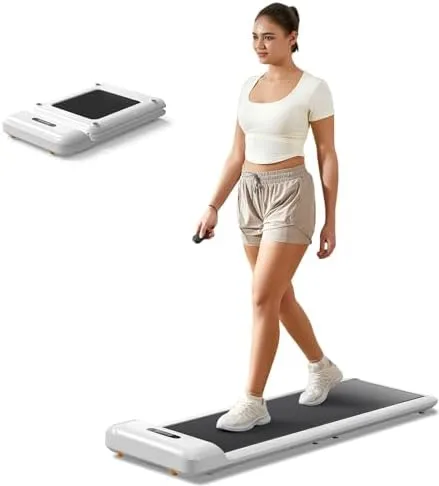
Best for: anyone who wants a low-profile walking pad for under-desk use at home or in an office, at $349.
Strengths
The footprint carries this one. The deck runs 56.9 inches long, 20.4 wide, and 4.9 high. It sits low enough to slide under a desk, and it folds to 32.5 x 20.4 x 5.4 inches for storage. At 55 pounds with an aluminum frame, it moves without feeling flimsy.
Speed runs 1 to 4 mph off a 2 hp motor. That’s a walking range, with a slow jog at the top end. Control comes through the FootSense system, an LED display, and the included remote. You also get a power cord, tool kit, and user manual.
Buyers keep pointing to durability. Across 221 ratings at 4.4 out of 5, the recurring praise is longevity. Owners report the unit keeps working as intended instead of developing early problems.
Weaknesses
The 220-pound maximum user weight rules out some shoppers. The 4 mph ceiling means this is not a running machine. Anyone wanting real cardio pace should look elsewhere. The warranty runs one year from the manufacturer—short for a $349 corded unit.
Verdict: Buy if you want a foldable, durable walking pad for desk work and daily steps, and you’re under 220 pounds. Skip if you need running speeds or a longer warranty.
Verdict: For $349, the C2 is a solid under-desk walker if you stay under 220 pounds and accept a walking pace. Durability earns the price. The short warranty and 4 mph cap are real limits. Buy it for daily steps, not running.
I recently bought the Walkingpad C2 because it sounded great on paper- it folds, it's (relatively) compact, it looks nice, and it was well reviewed on websites and recommended on Reddit as well.
This sounds bad already but this started happening the 2nd time I used it and it has deteriorated substantially already in the 3 weeks or so I've owned it.
While it is not silent, and I did put the walking pad on top of my rug, it is relatively quiet.
Viamotion Walking Pad with Incline and Handle Bar: Best Budget
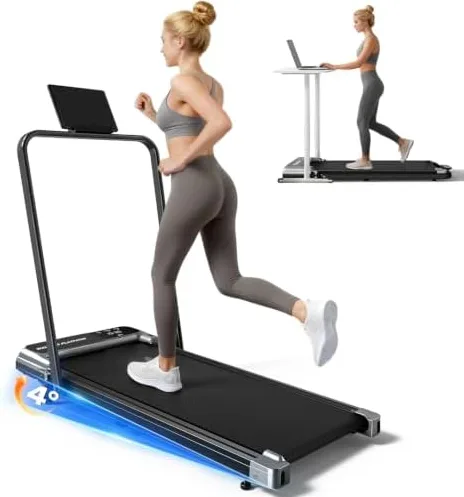
Best for someone who wants to add walking to a workday or TV hour without dedicating a room to a treadmill.
At $109.99, the entry cost stays low. The 2.5 hp motor backs the 3.8 mph top speed—enough for a walking pace, not for running. The deck supports up to 265 pounds. The LED display reports speed, time, distance, and calories. An IR remote lets you change settings without breaking stride. Manual incline reaches 4 percent. Folded, it measures about 45.5 by 21 by 40.5 inches, which makes it practical under a desk or against a wall. Across 1,911 reviews, it averages 4.3 out of 5. Owners report it holds up over long-term use and say it changed how much they move during the day.
The complaint that keeps surfacing? Boredom and low motivation. A walking pad is repetitive. The 3.8 mph ceiling leaves nowhere to push harder when you want to. The plastic frame and hand-set incline won’t feel like gym equipment. Adjustments are something you do yourself.
Buy if you want affordable, foldable walking minutes during desk or couch time. Skip if you need running speeds, motorized incline, or a machine that keeps the workout interesting without effort on your part.
Verdict: Viamotion’s $110 walking pad is the value pick for adding steps while you work or watch TV—reliable, foldable, and desk-friendly. But if you need running speed, auto incline, or built-in motivation, this isn’t it. The boredom will get you before the machine does.
I got ours in Nov 2022, and walking a few hours a week combined with doing weight watchers, I lost 25 pounds over the span of a 5-6 months last year.
I removed my option for a seated desk because I was worried I would just phase the walking out, so that probably helped a bit with the dedication.
The pad has been beaten into the ground (I used it on speed 4 for the whole 99 minutes every time I used it) and it squeaks a loooot.
MERACH UltraWalk W60: Best for Heavy Users
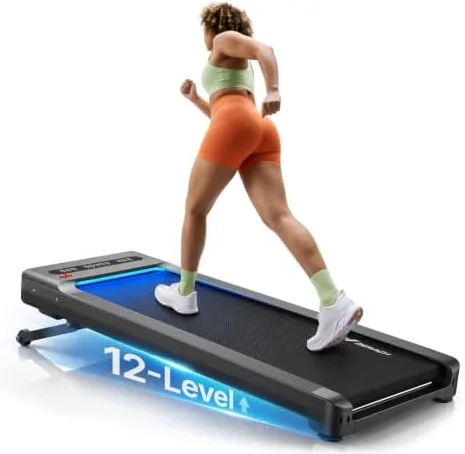
Best for heavy users who want incline walking—not running—in a low-profile deck that fits under a desk or against a wall.
The headline number is the 400-pound weight capacity paired with a 12% auto incline. That combination is rare in this category. It’s why this unit is aimed at bigger walkers rather than casual steppers. The 3.5HP motor is sized to move that load at incline without straining. The deck measures 51.4” deep by 22” wide at just 6.5” high, so taller users get usable stride length while the frame still slides under most standing desks. Bluetooth and app connectivity plus the included remote let you change speed and incline without bending down. The 2-year warranty and 4.2/5 rating across 106 reviews round out a reasonable package at $429.99.
The honest limits: top speed is 4 mph, so this is strictly a walking machine. Anyone planning to jog will outgrow it fast. The included components list only a remote, with no handrails. That means 12% incline work puts balance entirely on you. At 67.7 pounds, it’s wheeled and movable, but it isn’t something you’ll lift onto a shelf between uses.
Buy if you want a high-capacity inclined walker for standing-desk use. Skip if you want to run or need handrail support.
Verdict: The W60 is the rare pick for heavier walkers who need a 12% incline and 400-pound capacity under a desk. If you want to run or need handrails, keep shopping.
Immediately out of the box, I was surprised that the Merach walking pad felt heavy and substantial, more like a solid piece of exercise equipment than some of the flimsy walking pads I’ve seen out there.
So far the unit does warm up, which is normal, but it doesn't get hot like the past walking pads, which laid flat on the carpet.
I primarily used this on a rug and on hardwood, and it was simple to move this around my space.
Egofit Walker Pro: Best for Standing Desks
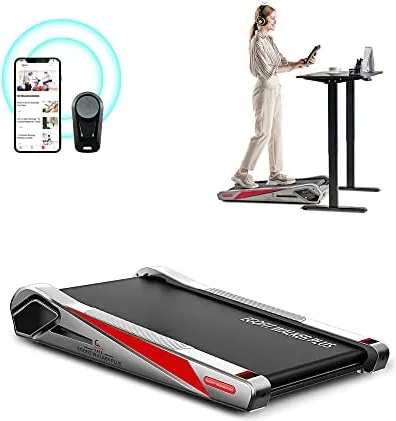
Best for someone who wants to log walking miles under a standing desk without giving up floor space. Not for runners.
The deck measures 51 inches long and 16.5 inches wide. Owners report the stride fit works across a range of heights. Speed runs from 0.62 to 3.1 mph, so it tops out at a brisk walk. That ceiling matches the 3 mph speed rating rather than exceeding it. Folding down to 19.19 x 13.09 x 3.45 inches lets it tuck away when the workday ends. It weighs 55 pounds. The unit ships installation-free with a remote and power cord, carries a 1-year warranty, and lists auto lubrication as a maintenance feature. A 2 hp motor, 550 watts, and a 5% maximum incline cover light walking. The 6.89-inch LCD reports speed only. Maximum recommended user weight is 242 pounds.
Two problems recur across the 170 reviews (4.2 out of 5): loud operation, and mechanical defects or unusual noises. Buyers describe the noise as ongoing rather than something that fades after break-in. Some report sounds pointing to a defect.
Buy if you want a compact walking pad near $190 for a standing desk and noise won’t bother you or your neighbors. Skip if quiet operation matters, or if you want to run.
Verdict: Owners report loud operation and mechanical issues, so this is a gamble. It folds small and fits varied strides, but only walks. Buy for storage. Skip for quiet or reliability.
Hi, I just bought one and it arrived broken (one of the wheels was broken off and rattling around inside the engine compartment).
I just got one and I love it! I used it for 5 hours a day both yesterday and today while working, about 12 miles each day.
I’m a little shorter than 5’5” and I notice no difference from walking on my regular treadmill.
WalkingPad P1: Best for Small Spaces
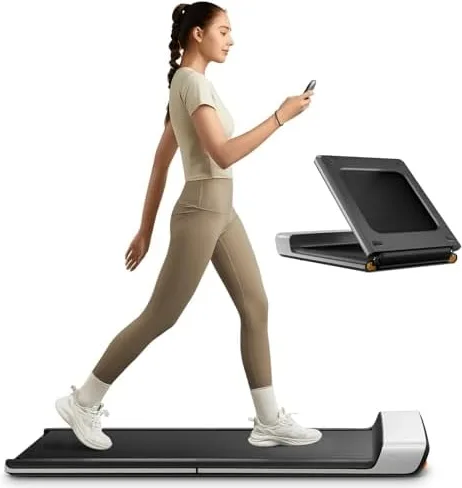
Best for: anyone with a tight floor plan who wants daily walking miles, not running miles. The 3.75 mph ceiling keeps things at a walk.
At $449, the P1 folds in half to 32.5 x 21.5 x 5 inches. It stows out of the way in a small room between sessions. Unfolded, it runs 56.5 inches deep with a 40-inch walking belt—enough for a full stride between 0.5 and 3.75 mph. The motor is rated 2 hp with 800 watts of input power. The display reports time, speed, distance, and calories—the four numbers most walkers actually want. It holds up to 220 pounds and includes a remote, power cord, tool kit, and manual, backed by a one-year manufacturer warranty. At 62 pounds, one person can shift it around. Lifting it onto a shelf is a two-hand job.
The recurring complaint across the 1,238 ratings (4.2/5 average) is durability. Owners report wear and mechanical problems after limited use, especially among people who fold and unfold the deck frequently. Folding is the headline feature. It’s also the part that seems to age fastest.
Buy if you need a walking-only machine that disappears into a small space and you’ll treat folding as occasional. Skip if you want to run, weigh over 220 pounds, or plan to collapse it several times a day.
Verdict: The WalkingPad P1 nails compact storage and comfortable walking speeds, but its folding mechanism becomes its weakest link under daily use. At $449, it’s a fair buy for occasional fold-away walkers under 220 pounds. Anyone who plans to collapse it daily should spend more for a sturdier hinge.
I had gone through the same hesitation and was thinking about getting a treadmill instead, but we are tight for space and so I went with the WalkingPad. No regrets.
I have a walkingpas c1, and I use it every day. It's been two years, and it's still going strong. I dont fold it up often though, it just stays under my desk.
This sounds bad already but this started happening the 2nd time I used it and it has deteriorated substantially already in the 3 weeks or so I've owned it.
Specs at a Glance
| # | Product | Award | Price | Rating | |
|---|---|---|---|---|---|
| 1 | WalkingPad C2 Foldable Walking Pad Treadmill, Under Desk Compact Design | best overall | $349 | 4.4/5 | Check price |
| 2 | Walking Pad Treadmill for Home, Walking Pad with Incline and Handle Bar | best budget | $109.99 | 4.3/5 | Check price |
| 3 | MERACH UltraWalk W60 Walking Pad Treadmill with 12% Auto Incline, Under Desk Walking Pad 400lb Capacity, Max 3.5HP Heavy Duty Walking Pad with Incline for Tall People with BT Speaker, RGB Light & APP | best for heavy users | $429.99 | 4.2/5 | Check price |
| 4 | Egofit Walker Pro Under Desk Motorized Folding Small Walking Treadmill for Home & Office, Installation-Free with LCD Display, Compact Fit Standing Desk Treadmills | best for standing desks | $189.99 | 4.2/5 | Check price |
| 5 | WalkingPad Foldable Walking Pad Treadmill, Compact Under Desk Design | best for small spaces | $449 | 4.2/5 | Check price |
What to Look for in an Under Desk Walking Pad
Start with speed range. Walking pads are built for slow, steady movement rather than running. A range that tops out around 3 to 4 mph suits most standing-desk work. Anyone wanting a light jog between meetings should look higher. Check the minimum speed too. The lowest setting is the one you’ll actually live at.
Next, dimensions. Measure the footprint of your desk’s under-area and the length of your stride before buying. A pad that is too short forces a shortened gait. Owners report that becomes uncomfortable within an hour.
Weight limit matters more than it looks. Manufacturers publish a maximum user weight. Buyers mention that running close to that ceiling tends to shorten motor life. If two people share the pad, size for the heavier one.
Foldability is the trade-off. Foldable models store upright and roll away, but they often carry lower weight limits and narrower belts. Flat, non-folding units are heavier and stay put.
Finally, read owner feedback on noise and belt tracking—the two complaints that come up most.
Questions before you buy
Will a walking pad fit under a standard standing desk?
Several of these are slim enough to slide under a desk — the NEWBULIG is 3.6 inches tall, the WalkingPad Z1 is 4.1, the C2 is 4.9, and the P1 is 5 — but since no standard-desk clearance is given, measure the underside of your desk and compare it to the pad's height; the MERACH W60 at 6.5 inches is the tallest here, and the Viamotion's 37.4-inch handle-bar height would keep it from tucking under at all.
How fast do under desk walking pads go?
Most under-desk walking pads in this guide top out at 4 mph, including the WalkingPad C2, WalkingPad Z1, and MERACH UltraWalk W60, while the WalkingPad P1 reaches 3.75 mph and the NEWBULIG peaks at 3.1 mph. Minimum speeds range from 0.5 mph on the WalkingPad P1 to 1 mph on the WalkingPad C2 and Z1.
Are foldable walking pads sturdy enough for daily use?
Owners report mixed sturdiness for daily use: the WalkingPad C2 ($349) is cited for durability and longevity, while the WalkingPad P1 ($449) draws complaints about durability and wear. Weight capacity is the clearest sturdiness indicator, ranging from 200 pounds on the NEWBULIG to 400 pounds on the MERACH UltraWalk W60, so match your own weight to that rating before buying.
How loud is a walking pad in a shared office?
Decibel ratings aren't listed for any of these walking pads, so there's no single loudness figure to give for a shared office — the closest notes are the WalkingPad Z1's reported motor noise and whine, while the Viamotion Walking Pad Treadmill is described as quiet. Buyers sharing an office should check the manufacturer's dB spec or owner reviews for the specific model before buying.
What weight capacity should I look for?
Capacities in this guide run from 200 pounds on the NEWBULIG Under Desk Walking Pad to 400 pounds on the MERACH UltraWalk W60, with most models landing between 220 and 265 pounds. Pick a capacity comfortably above your own weight, and if you plan to jog rather than walk, lean toward the higher-rated frames like the MERACH or the 265-pound Viamotion.
Does an incline make a walking pad better for working?
Only two pads here list an incline — the Viamotion at 4% manual and the MERACH UltraWalk W60 at 12% auto — and nothing in their specs says an incline makes them better for working, so check whether the raised deck still clears your desk and keeps you at a comfortable typing height before choosing.
How much space does a folded walking pad need for storage?
Folded walking pads in this guide generally need a storage footprint of about 32 inches long by 20 to 22 inches wide and 5 to 5.5 inches tall — for example, the WalkingPad P1 folds to 32.5 x 21.5 x 5 inches, the C2 to 32.5 x 20.4 x 5.4 inches, and the Z1 to 31.8 x 22 x 5.4 inches. For models without a listed folded size, such as the Viamotion (45.53 x 21.17 x 40.47 inches folded) or the NEWBULIG and MERACH pads, check the manufacturer's folded dimensions directly before buying.
What is the difference between a walking pad and a treadmill?
The guide's listings don't spell out the walking pad vs. treadmill distinction, so check each product's top speed, handrails, and incline before buying. In this set, for example, the Viamotion model includes a handle bar and a 4% manual incline, while the foldable units like the WalkingPad P1 (3.75 mph max) and C2 (4 mph max) are handle-free and designed for under-desk use.