Best Walking Pad for Shared Households in 2026: 4 Picks Ranked
- Updated
- Picks
- 4
- Edition
- No. 1
- Published by
- Try Mersianto
For most shared homes, the MERACH UltraWalk W60 offers the best mix of 400-lb capacity, 12% incline, and quick adjustments. The MERACH W50 is the budget pick, the WalkingPad C2 folds smallest, and the Z1R adds a handle bar.
Why Shared Households Need a Walking Pad That Works for Everyone
A walking pad that fits one person rarely fits a house of two or three. The mismatch shows up in three spots: settings you redo every time someone else steps on, a weight rating that only clears the lighter users, and a deck parked in the middle of the living room because there’s nowhere else to put it.
In a shared home, the filter tightens. The pad has to switch from one user to the next in seconds. Nobody should rebuild the setup before each walk. It has to be rated for the heaviest person in the house. That highest weight sets the floor, and anything lower is a return waiting to happen. It also has to store without taking over the room—folded or rolled into a closet, under a bed, or flat against a wall.
Buyers in shared homes mention all three. Those three points decide the picks below.
Best Overall: MERACH UltraWalk W60
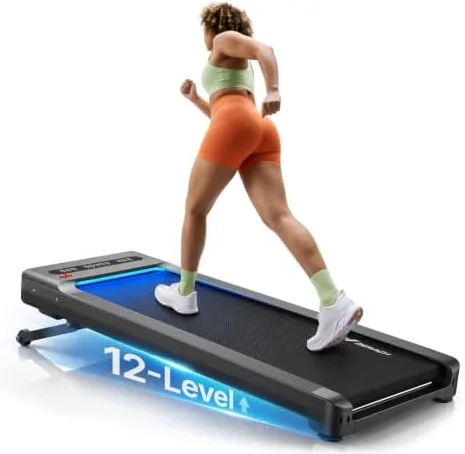
Best for: desk workers and adults who want incline walking at a 400-pound capacity without giving up floor space to a full treadmill.
The specs carry the argument. Max 3.5 horsepower. A 400-pound weight limit. A 12% auto incline—that’s the differentiator, because a walking pad that changes elevation instead of just speed delivers a different workout. Top speed is 4 mph. That’s walking territory, not running. The box includes a remote, Bluetooth and app connectivity, a built-in speaker, and an alloy steel frame. The unit measures 51.4 by 22 by 6.5 inches, weighs 67.7 pounds, and rolls on wheels when you need to move it. Buyers sum it up as better than other walking pads.
Two caveats. The listing gives 51.4 inches of overall depth but never breaks out the usable belt length. Tall buyers can’t confirm stride from the specs alone, so verify that before trusting the “tall people” label. And the review base is modest: 4.4 out of 5 across 170 ratings, with durability past the 2-year warranty unproven.
Buy if you want incline walking under a desk with heavy-duty capacity. Skip if you need running speeds or a belt length you can check before ordering.
Verdict: The W60 is a heavy-duty incline walking pad, not a treadmill. Buy it for the 400-pound capacity, 12% incline, and desk use. Skip if you need running speeds or verified stride length for tall legs. The two-year warranty is fine, but longevity beyond that remains unproven.
Immediately out of the box, I was surprised that the Merach walking pad felt heavy and substantial, more like a solid piece of exercise equipment than some of the flimsy walking pads I’ve seen out there.
So far the unit does warm up, which is normal, but it doesn't get hot like the past walking pads, which laid flat on the carpet.
I primarily used this on a rug and on hardwood, and it was simple to move this around my space.
Best Budget: MERACH W50
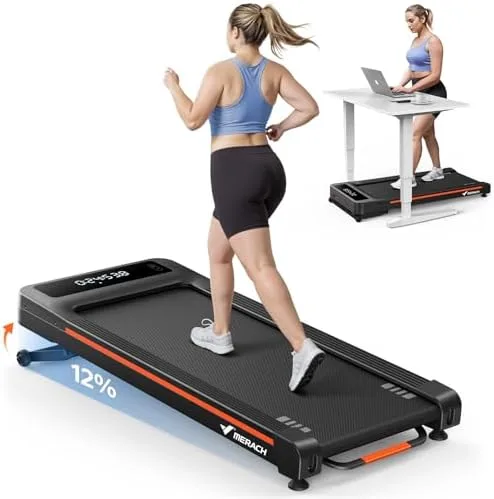
Best for: a walker who wants incline in a sub-$350 under-desk pad and will keep the pace under 3 mph.
The 12% auto incline is the reason to look here. Most pads at $329.99 are flat, and a powered incline at this price is uncommon. The 3.5 HP brushless motor, 4 mph ceiling, and 400 lb capacity put this in walking-only territory. That’s fine for desk work and light incline intervals, not for running. The deck measures 16.5” x 41.3”. The whole unit is 50.2” x 22.2” x 6.1” and 68 lbs, so it rolls under a desk and stores against a wall. You get a 2-year warranty and a remote. Buyers rate it 4.3 out of 5 across 223 reviews, and overall satisfaction is the most common positive.
The complaints are consistent and worth weighing. Owners report the motor bogging down or overheating under sustained use. Some mention units stopping entirely after a short time. That undercuts the 3.5 HP figure. Treating this as a light-duty machine matches what reviewers describe. At 68 lbs of alloy steel, repositioning is a two-hand job.
Buy if you want incline walking at a budget price and will use it in short, moderate sessions. Skip if you plan long daily sessions, faster paces, or need a motor that holds up to heavy load.
Verdict: MERACH promises 400-pound capacity and 12% incline, but owners report motor bogging and premature failure. That mismatch means the spec sheet oversells the machine. Worth a gamble only for light, short walking sessions—not for heavy users or daily miles.
I did one hour at 3mph and 4% incline and I swear the motor was beginning to overheat already. I just replaced my GoPlus with this shit because of the 3.5hp advertising.
So far the unit does warm up, which is normal, but it doesn't get hot like the past walking pads, which laid flat on the carpet.
It died after 1.5 months with the Merach T25. Well, not completely. But it majorly bogged down with every step.
Best for Small Spaces: WalkingPad C2
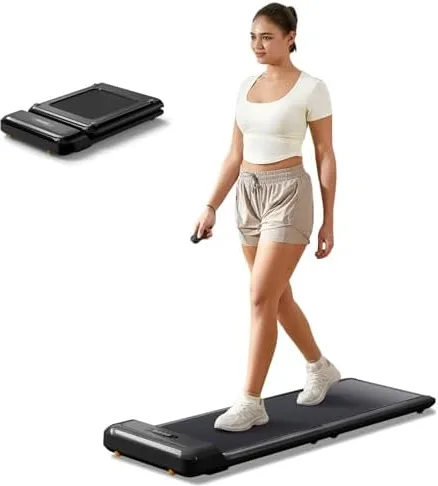
WalkingPad C2 review: a small-space walker with clear limits
This pad is for apartment dwellers and remote workers who want daily steps under a desk without giving up a room.
The footprint is the point. It sits 4.9 inches off the floor and measures 56.9 inches long by 20.4 inches wide, so it slides under most standing desks. Folding drops it to 32.5 x 20.4 x 5.4 inches for closet storage. At 55 pounds, one person can reposition it. The 2 hp motor starts at 1 mph and tops out at 4 mph, covering walking and light jogging. An LED display tracks calories, time, distance, and speed. The FootSense control lets you change pace by foot position instead of reaching for the included remote. Owners report it runs quietly enough to stay on work calls, and buyers mention reliability holding up over months of use. It averages 4.5 out of 5 across 212 reviews.
Two limits matter. The 220-pound user weight cap rules out heavier walkers. The 4 mph ceiling means you can’t run on it. There’s no incline.
Buy if you want quiet under-desk walking in a tight space. Skip if you need running speeds, incline, or a higher weight rating.
Verdict: The WalkingPad C2 is the right under-desk pad for light, apartment-scale walkers who want quiet steps and fold-away storage. The 220-pound limit and 4 mph top speed are hard lines: buy it for daily walking, not for running or heavier users.
I recently bought the Walkingpad C2 because it sounded great on paper- it folds, it's (relatively) compact, it looks nice, and it was well reviewed on websites and recommended on Reddit as well.
This sounds bad already but this started happening the 2nd time I used it and it has deteriorated substantially already in the 3 weeks or so I've owned it.
While it is not silent, and I did put the walking pad on top of my rug, it is relatively quiet.
Best for Shared Beginners: WalkingPad Z1R
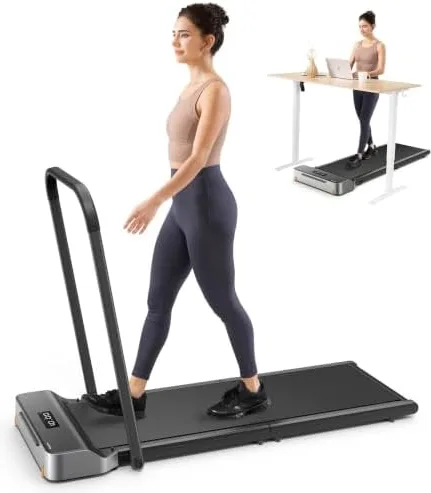
Best for: beginner households where two or more people share one machine and want a handle to hold onto while they build up to jogging.
The 20-by-55-inch deck is the headline for shared use. It gives beginners real room to walk without clipping the sides, and the 243-pound user limit covers most adults in a house. Speed runs from 0.5 to 7.5 mph. That means the same unit works for a slow first walk and a later jog. The 12% incline adds resistance without requiring a separate machine. The handle bar matters here: new walkers who wobble at 3 mph have something to grab. ANT+, Bluetooth, and USB let users push heart rate, distance, and calorie data to an app instead of staring at the 5-inch LCD. A 1-year manufacturer warranty is attached.
The honest problem is longevity. Buyers mention durability and quality issues often enough that it’s the recurring complaint in the review pool. The 4.4-star average across 302 reviews comes with that caveat, not against it.
Buy if you want one foldable unit at $559 for several beginners to share and you accept that it may not be a decade-long purchase. Skip if you need a machine built to survive daily hard running, or if you expect commercial-grade construction from a folding design.
Verdict: The Z1R’s 20-by-55-inch deck, 7.5 mph top speed, 12% incline, and handle bar make it a solid shared-home beginner treadmill, but owners’ durability complaints and the 243-pound limit cap it as light-duty. Buy it for walking and light jogging; don’t expect commercial longevity.
Is squeaks, motor makes wierd nosie for the first few minutes after starting and only after 45 minutes it seems to overhear and plastic smells.
I have been using Kingsmith Z1 Fold for 6 months and it starts to fall apart.
I did use it a lot, to be honest (~15k steps a day).
Shared-Home Walking Pad Comparison: Capacity, Incline, and Folded Size
| # | Product | Award | Price | Rating | |
|---|---|---|---|---|---|
| 1 | MERACH UltraWalk W60 Walking Pad Treadmill with 12% Auto Incline, Under Desk Walking Pad 400lb Capacity, Max 3.5HP Heavy Duty Walking Pad with Incline for Tall People with BT Speaker, RGB Light & APP | best overall | $479.99 | 4.4/5 | Check price |
| 2 | MERACH Walking Pad with Incline 12% Auto Treadmill for Home, 400lbs Capacity 3.5HP Super Quiet Brushless Walking Pads Under Desk, 16.5”x41.3” Mat Walk Pad with Remote & LED W50 Walking OAD | best budget | $329.99 | 4.3/5 | Check price |
| 3 | WalkingPad C2 Foldable Walking Pad Treadmill, Under Desk Compact Design | best for small spaces | $499 | 4.5/5 | Check price |
| 4 | WalkingPad Z1R Foldable Walking Pad with Handle Bar Under Desk Treadmill | best for shared beginners | $559 | 4.4/5 | Check price |
How to Choose a Walking Pad for a Shared Household
A shared walking pad has three jobs at once: switch between users quickly, support the heaviest person in the house, and get out of the way afterward.
Start with speed control. Remotes, preset buttons, and single-step speed keys let one user finish and the next start without scrolling through a menu mid-session. Owners mention that speed changes are where shared use gets clumsy, especially when two people trade off back to back.
Match the deck length to the tallest user’s stride. Match the stated weight capacity to the heaviest user, not the household average. A pad rated close to a user’s weight leaves little margin. The capacity figure is usually printed on the spec sheet.
For storage, check deck thickness, the unit’s own weight, and whether it rolls or folds. Anything that has to be lifted onto a shelf tends to stay parked in the middle of the room. Belt width is the final tradeoff: wider decks are steadier under a long stride but heavier to move.
Questions before you buy
Can a shared walking pad handle users of different weights?
Yes, as long as every user stays under the unit's maximum weight recommendation, which varies widely by model: the MERACH UltraWalk W60 supports up to 400 pounds and the MERACH W50 up to 397 pounds, while the WalkingPad C2 caps at 220 pounds and the WalkingPad Z1R and X Series at 243 and 242 pounds. For a shared pad, pick a model whose limit exceeds your heaviest user's weight, and check owner feedback on motor performance under load since heavier users can strain lower-power units.
How much weight capacity do I need for a shared household?
For a shared household, choose a capacity at least as high as your heaviest user, so the MERACH UltraWalk W60 (400 pounds) or MERACH W50 (397 pounds) covers most couples, while the WalkingPad C2 tops out at 220 pounds and the WalkingPad Z1R at 243 pounds. If any household member weighs close to or above those lower limits, step up to a higher-rated model rather than splitting the difference.
Do I need a folding walking pad in a small shared home?
Yes, if floor space is tight in a shared home, a folding model like the WalkingPad C2 ($499) collapses to 32.5 x 20.4 x 5.4 inches and owners report quiet operation that's suitable for calls, while non-folding pads such as the MERACH W50 ($329.99) stay at their full 50.2 x 22.2 x 6.1 inches.
How quiet is a walking pad for a shared apartment or office?
The WalkingPad C2 (($499)) is the only pad here noted for quiet operation for calls, so it's the best fit for a shared apartment or office. The other pads (MERACH W50, W60, WalkingPad Z1R and X214) list no noise specs, so check owner reviews or decibel ratings for those before buying.
Can you use a walking pad with incline under a standing desk?
Yes — the MERACH W50 (6.1 inches high, 12% auto incline) is explicitly recommended for under-desk use, and the MERACH UltraWalk W60 offers the same 12% incline at 6.5 inches high, so both are designed to slide under a standing desk. Check your desk's minimum and maximum height range to confirm it clears the deck once the incline is raised.
How do you switch settings between users on a walking pad?
None of these walking pads list multi-user profile switching in their specifications, so there is no documented way to save or swap settings between users. Buyers who need that feature should check the user manual or contact the manufacturer for the MERACH W50, MERACH UltraWalk W60, WalkingPad Z1R, C2, and X214 directly.
Is a handle bar worth it for beginners sharing a walking pad?
For a beginner sharing a walking pad, the handle bar option is the WalkingPad Z1R at $559, the only model here with a handle bar and the only one listing beginners in its target audience (along with adults and intermediate users). It reaches 7.5 mph and supports up to 243 pounds, but its sole listed drawback is durability and quality issues, and no comparison data exists for handle-free sharing, so check whether everyone's stride and height fit the 20-by-55-inch deck.
How heavy are these walking pads to move and store?
The MERACH W50 weighs about 68 pounds, the MERACH UltraWalk W60 is 67.7 pounds, the WalkingPad C2 is roughly 55 pounds, and the WalkingPad X Series is 95.2 pounds; the C2 folds to 32.5 x 20.4 x 5.4 inches and the X Series to 40 x 28 x 8.6 inches for storage. The WalkingPad Z1R listing gives no weight, so ask the seller for that before buying.